

⚡ TLDR
The busiest repositories on GitHub today take a few dozen writes in a single second, in short bursts. GitHub’s new storage architecture, Project Rubicon, was tested at 5,000 concurrent agents sending 7,200 pushes per second to one repository, with read latency staying flat.
The whole design comes from one observation about Git:
Objects are immutable and named by their content hash, so two writers can store them at the same time without agreeing on anything
The only part of a push that needs ordering is the reference update, and a reference update is tiny
So Rubicon splits durable state in two. Packs go to Azure Blob Storage, written in parallel by any number of nodes. References go to a small replicated log called Ref-CAS, which does a quorum-committed compare-and-swap per reference. Compute is a fleet of disposable replicas whose local disk is only a cache.
The idea worth keeping: before you scale a consensus system, check how much of each write needs consensus at all. GitHub got two orders of magnitude by moving megabytes out of the agreed-upon path and leaving a few bytes in it.
One more thing before the architecture. Everything below exists so that 5,000 agents can push to one repo at once. Nothing in it makes any of those agents better at the job. An agent that makes a bad call on Monday will make it again on Tuesday, and at this scale it will make it 5,000 times. GitHub’s own roadmap has a line item for it: agents make the same mistakes developers do. Today’s sponsor works on that half of the problem.
Stop shipping agents that repeat mistakes.

Zep Agent Skills turns your agents’ traces into step-by-step skills they read at runtime, over MCP or the Zep SDKs.
More tasks done right: agents start from steps that work instead of from zero.
Fewer tokens: agents take fewer steps, and a smaller model can use a skill from a larger model’s run.
Works with your agent infra: use any framework, and bring traces from Braintrust, LangSmith or the Zep SDK.
Free on every Zep plan until January 4.
📈 Why “dozens per second” stopped being enough
GitHub thinks about scale on two axes. Horizontal is how many people and agents work across many repos, and that part is mostly solved with tenant partitioning, fairness, and load-aware routing. Vertical is how many writers can work on one repo, and that’s where agents changed the math.
One repository’s daily requests grew about 4x between March and May and kept climbing. Agents work in parallel and around the clock, so what used to be a burst becomes a sustained rate. Every push also triggers reads: CI pulls it, deploy systems pull it, other agents fetch it for context. Write volume drags a multiple of itself in read volume behind it.
The requirements for a single repo came out as:
Thousands of writes per second
Multiple writer nodes, because indexing an incoming pack and checking object connectivity are the CPU-heavy parts of a write, and one node goes compute-bound fast
Low commit latency, since an agent blocks on each push before its next step
Per-reference ordering, with a quick way to linearize across references
Reads that cost almost nothing when the repo hasn’t changed, which is the common case
Every component scaling independently
The target was at least 100x current load. The team decided to skip the next increment and design for that.
🧭 A push, end to end
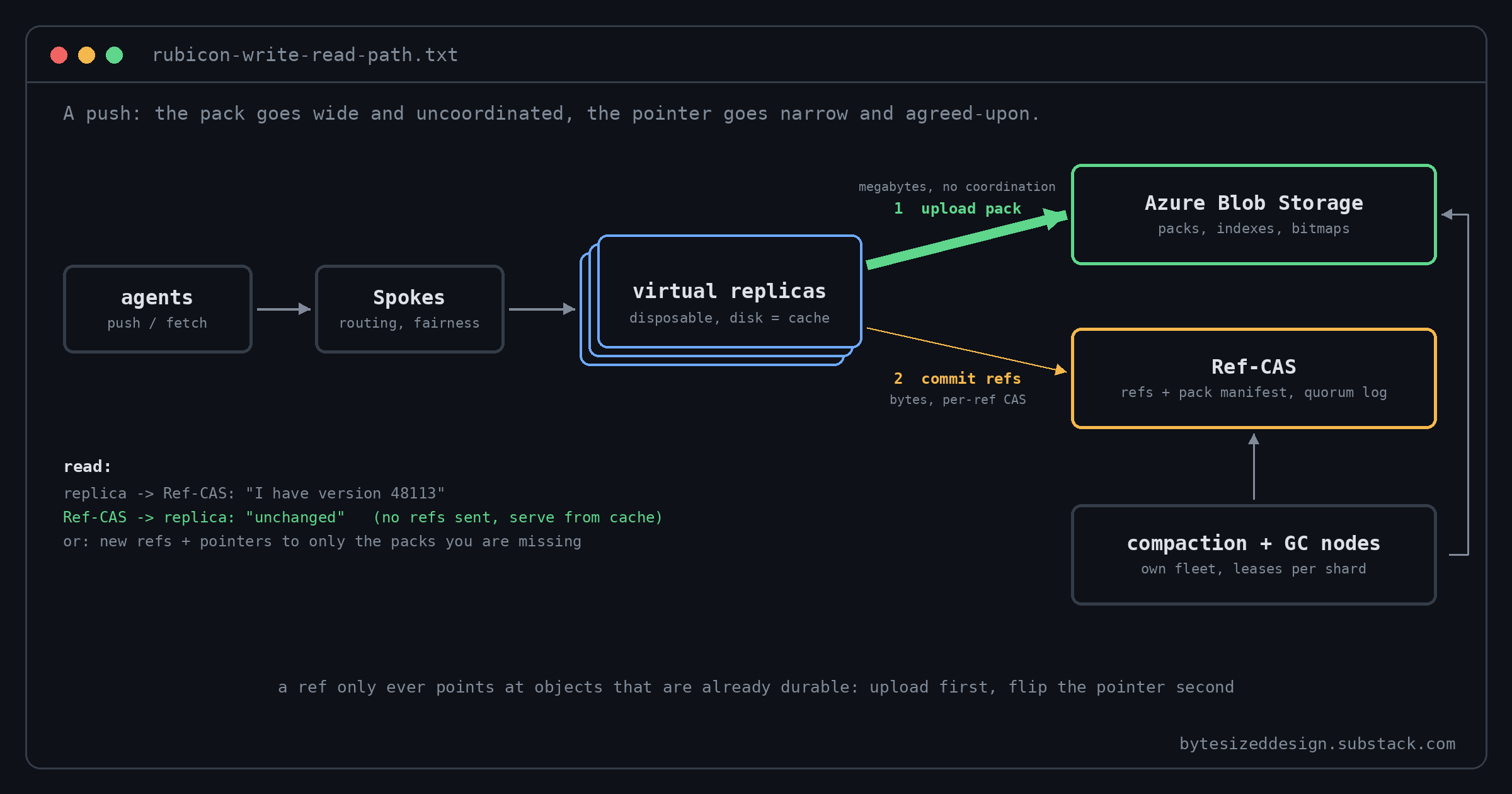
The front door is unchanged: requests still land on Spokes, which does routing, placement, and tenant fairness. The data plane underneath it is all new.
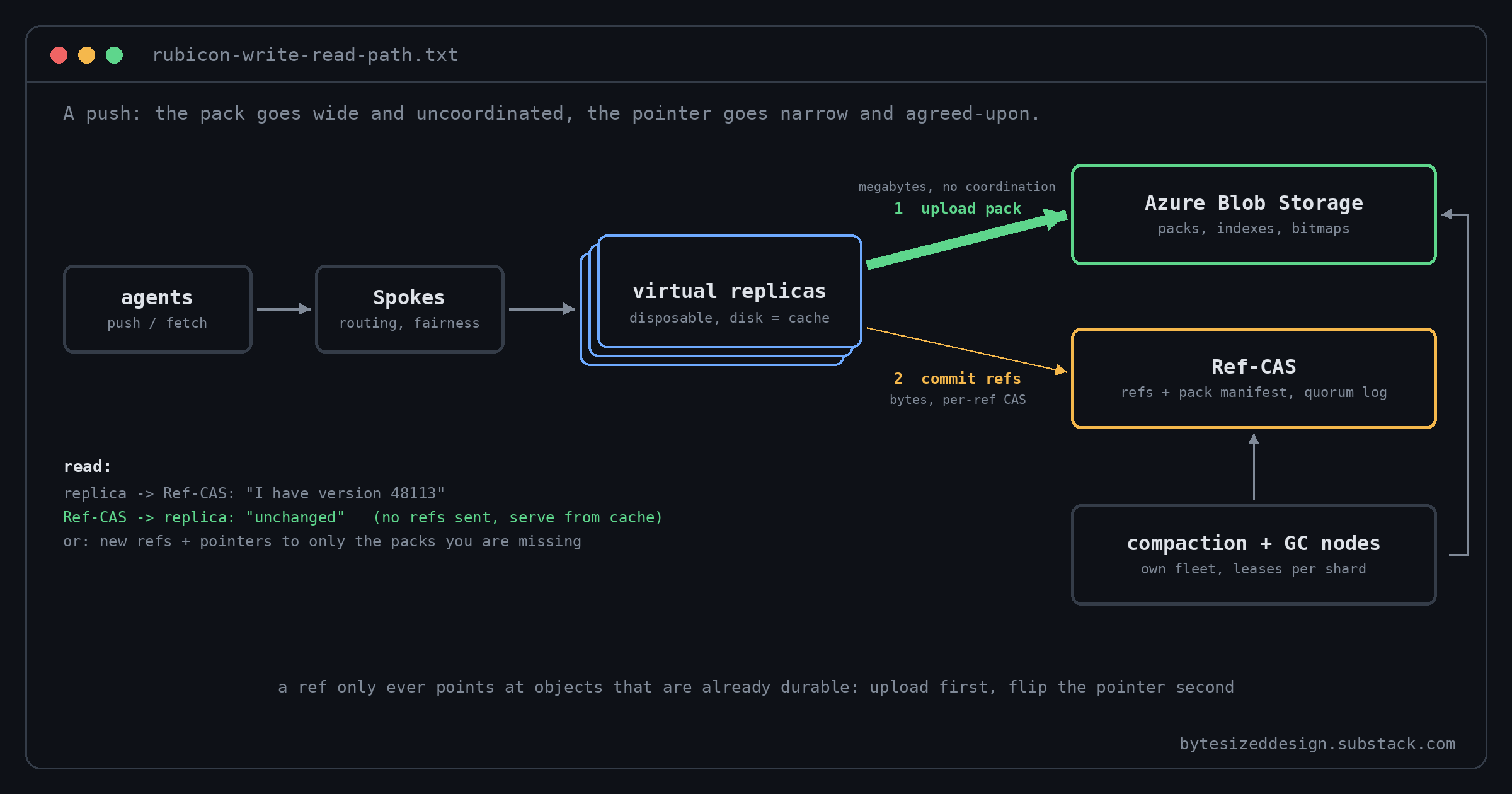
Virtual replicas are one fleet of disposable compute that serves reads, writes, or both. Spokes tries to send a repo’s traffic to the same replicas to keep caches warm, but correctness never depends on which replica a request hits. Lose one and the others keep serving while a replacement fills its cache from traffic.
A write goes like this:
A virtual replica indexes the incoming pack
It uploads the pack to Blob Storage
It commits one transaction to Ref-CAS that adds the pack to the manifest and updates the references
The order of steps 2 and 3 is the safety property. A reference can only ever point at objects that are already durable, because the pack lands before the pointer moves.
A read starts with a version check. The replica tells Ref-CAS which version of the reference state it holds. If nothing changed, the reply carries no references at all and the read is served from cache. If the replica is behind, it gets the current references plus pointers to the packs it’s missing, and pulls only those.
🪣 Two prototypes that used Blob Storage as the database
This is my favorite part of the write-up, because the obvious design is the one they tried first and it almost works.
Object stores give you conditional writes, which is a compare-and-swap for free, on storage that’s already durable and replicated. If packs are going to Blob Storage anyway, keeping reference state there too means no new service to run.
Attempt one: a single blob. A write-ahead log for all of a repo’s references, indexed by one blob. Every update is a conditional write against it. Reads are cheap, since a replica just asks whether the blob changed. Writes hit a wall: only one conditional write to a blob can be in flight at a time. Even with every push that arrives mid-write batched into the next one, the ceiling is one write per round trip. That came out to mid-hundreds of writes per second.
Attempt two: segment blobs. Hash each reference to one of several blobs, so writes to different segments stop waiting on each other. The write ceiling goes up and the read path gets worse, because knowing whether anything changed now means checking every segment, and the read is as slow as the slowest one. Reads outnumber writes by orders of magnitude, so this traded the cheap thing for the expensive thing.
If you’ve been tempted to build coordination on top of S3 or Blob Storage conditional writes, this is a useful data point. It’s correct, it’s simple, and it holds up to a few hundred contended writes a second per key. Plenty of systems never need more than that. A repo with 5,000 agents does.
🔐 Ref-CAS: consensus on a few bytes
What replaced both prototypes is a replicated log service that handles references and nothing else.
Each reference update is a compare-and-swap committed by a quorum
A transaction locks only the references it touches and checks each still has the value the writer expected
It becomes visible once a majority of the log’s replicas have recorded it
Every commit gets a log sequence number, and the repo’s version is the LSN of its latest commit
Agents mostly push to their own branches, so most transactions touch disjoint references and replicate in parallel. When two pushes do hit the same reference, one appends and the other loses the CAS.
Ref-CAS never holds or validates object data. The consensus group in GitHub’s legacy architecture did, which is why it couldn’t go fast: every byte of every pack went through agreement. Now the agreed-upon state is a list of pointers, and the service transacts in the tens of thousands of operations per second.
One consequence the write-up doesn’t spell out: a push that loses its CAS has already uploaded its pack. That pack is durable and unreferenced, and it stays that way until garbage collection finds it. I think that’s the right trade, since storage is cheap and the alternative is holding a lock across an upload, but it means a hot contended ref generates garbage at the rate it rejects pushes.
🧹 Compaction moves off the serving path
Thousands of pushes a second means thousands of new packs a second. Git can serve from many packs, but every extra pack makes object lookup a little slower, so someone has to keep merging them.
In the old architecture, compaction ran on the same replicas that served traffic, and on every one of them. In Rubicon it runs on a separate fleet that works directly against Blob Storage and Ref-CAS:
A compaction node takes a lease on a shard of the repo’s packs, so one node owns a shard at a time
It reads the manifest for new packs and collects them into an open segment
When the segment hits a limit on count, size, or age, it’s sealed, and a new segment starts collecting behind it
The node merges the sealed segment’s packs into fewer, larger ones
It verifies the outputs contain exactly the same objects as the inputs
One transaction adds the new packs to the manifest. A second removes the inputs. Cleanup deletes them later
Each pack’s hash maps to a shard, so more shards and more nodes means more compaction throughput. A merged pack still under the size limit goes back into a shard by its own hash and merges again, so packs grow in tiers.
If this sounds familiar, it should. Immutable files written once, a manifest listing which files are live, background workers merging small files into bigger ones in tiers, and readers that consult the manifest: that’s an LSM tree with size-tiered compaction, with packs as the SSTables and Ref-CAS as the manifest log. The comparison is mine and GitHub doesn’t make it, but I find it reassuring. The storage engine pattern that’s carried write-heavy databases for fifteen years turns out to fit Git, because Git’s object model was already append-only and content-addressed.
Garbage collection is a separate pass with its own workers. Compaction keeps every object; GC removes the ones no reference can reach.
🚧 The ref this doesn’t parallelize
The headline number deserves a closer look. 5,000 agents at 7,200 pushes per second is 1.4 pushes per agent per second (my division), which no real coding agent does. It’s a stress test of the write path, and a legitimate one. It’s also a test where the writers mostly touch different references.
That’s the assumption carrying the design: agents push to their own branches. It’s true, and it’s also where the parallelism ends. Sooner or later that work has to land on main, and main is one reference. Per-reference CAS means exactly one of N concurrent updates to it wins. Rubicon makes it cheap to produce thousands of branches a second. It does nothing for the rate at which a team can merge them, and it isn’t trying to.
So the constraint moves again, and storage stops being the limit on how many agents can work in a repo, and the merge queue, CI capacity, and review become the limit instead. That’s the same pattern as Spotify’s doubled change volume: remove one bottleneck and the next stage inherits the queue. If you’re planning for agent-heavy development, the storage layer is about to be the part you don’t have to worry about. Budget the worry for whatever serializes on your default branch.
📌 What to steal
Measure how much of a write needs ordering. GitHub’s old write path put whole packs through consensus. The new one puts a pointer through. Look at your own quorum writes and ask which bytes two writers could disagree about
Durable first, visible second. Upload the data, then flip the pointer. A crash between the two leaves an orphaned pack for GC to collect, and every reference still resolves
Make the unchanged read a single comparison. One monotonically increasing version per repo lets every cache answer “am I current?” without fetching anything
Object-store CAS is a fine coordinator up to a few hundred writes a second per key. Past that you need per-item concurrency, and that means a real log
Run maintenance on its own fleet. If compaction shares CPU with serving, your p99 belongs to your background jobs
🤔 What’s missing
The numbers come from internal testing, and there’s only one latency claim (”consistently low”, “flat”) with no figures behind it. Commit latency was a stated requirement and the write-up never says what it is. Nothing covers Ref-CAS failure behavior: what a push sees during a leader change, or how long a replica can serve stale reads before it must re-check. Cost is absent, and a design that keeps every rejected push’s pack until GC has a storage bill worth knowing.
The architecture is in limited private preview with broader rollout planned for early next year, so the production numbers don’t exist yet. I’d read the next post in the series for those.
How many writes per second does your busiest repo take today, and do you know what serializes them? Hit reply. My bet is it’s the merge queue and it already hurts.
Source:
GitHub Engineering, Inside GitHub’s new Git storage architecture (Nov 5, 2026), Karthik Raman and Brian Celenza: https://github.blog/engineering/architecture-optimization/inside-githubs-new-git-storage-architecture/