

⚡ TLDR
Meta built one AI agent that knew everything about onboarding a data column into its recommendation pipelines: three repos, three languages, up to six pipeline stages, config schemas, codegen rules, population patterns for ten-plus data sources. It worked in demos. In production it started hallucinating, applying one subsystem’s naming conventions to another and using the wrong codegen pattern for the wrong data source.
The fix was to take knowledge away from the central agent. What replaced it:
A 1,300-line orchestrator that does zero domain work. It classifies intent, gathers fields, runs reliability checks, and routes
14 specialist subagents, each loaded with only its own domain and nothing else
Workflow templates, which are fixed state machines that sequence those 14 agents differently for each of 20+ use cases
Column config prep went from three to four days by hand, to about a day with an earlier config-driven system, to under an hour. Around two-thirds of the system’s changes land without significant human edits.
The rule underneath, which transfers to any agent system: for every component, decide whether it’s making a routing decision or a reasoning decision. Routing is deterministic and gets code. Reasoning gets an LLM, inside the smallest context that can do the job. Meta’s orchestrator follows seven steps per request and exactly one of them calls a model.
🫠 More context, worse agent
The pipeline is config-as-code. Python configs drive C++ code generation, which feeds data processing services, which populate analytics systems. One new column means coordinated edits across configuration registries, backend services, and pipelines, in the right order, kept in sync.
The first version was the obvious one. One agent, one giant prompt, every schema and rule and pattern loaded. It had everything it needed, and past some context size that became the problem. Knowledge from one subsystem leaked into decisions about another. The agent had plenty of information and was mixing it up.
A second attempt, still single-agent, got to 70 to 80 percent success, with a catch: an engineer had to hand-write a custom system prompt for each specific job. Take the handholding away and success fell to 10 to 20 percent. A system that only works when a human pre-chews the prompt per task is a system where the human is doing the orchestration.
Meta cites a Mount Sinai preprint on the same effect in a different domain: orchestrated multi-agent systems held 65.3% accuracy at 80-task batches where single agents fell to 16.6%, with up to 65x less token usage, attributed to task isolation preventing context interference. Different field, same shape of failure.
If you’ve read the agents-are-microservices edition, this is the monolith problem. A single agent with 40 tools and a 6,000-token system prompt degrades the way a 400,000-line app does. Every capability you add makes every other one slightly worse.
🚦 A router that refuses to think
The replacement has two layers, and the split between them is the whole idea.
The orchestrator is deterministic and does no domain work at all. It never reasons about code, never generates a config, never touches the codebase. For every request it runs the same seven steps:
Read the relevant subagent’s instruction file
Check whether the target already exists, to prevent duplicates
Gather required fields from the user
Auto-discover what can be inferred (repo type, existing configs)
Reliability gate: active warnings, required reviewers
Delegate to the subagent with full context
Handle results, surface errors, confirm success
Steps 1 through 5 and step 7 are plain code. Step 6 is the only place a model reasons, and it does so inside a subagent that has only its own domain loaded.
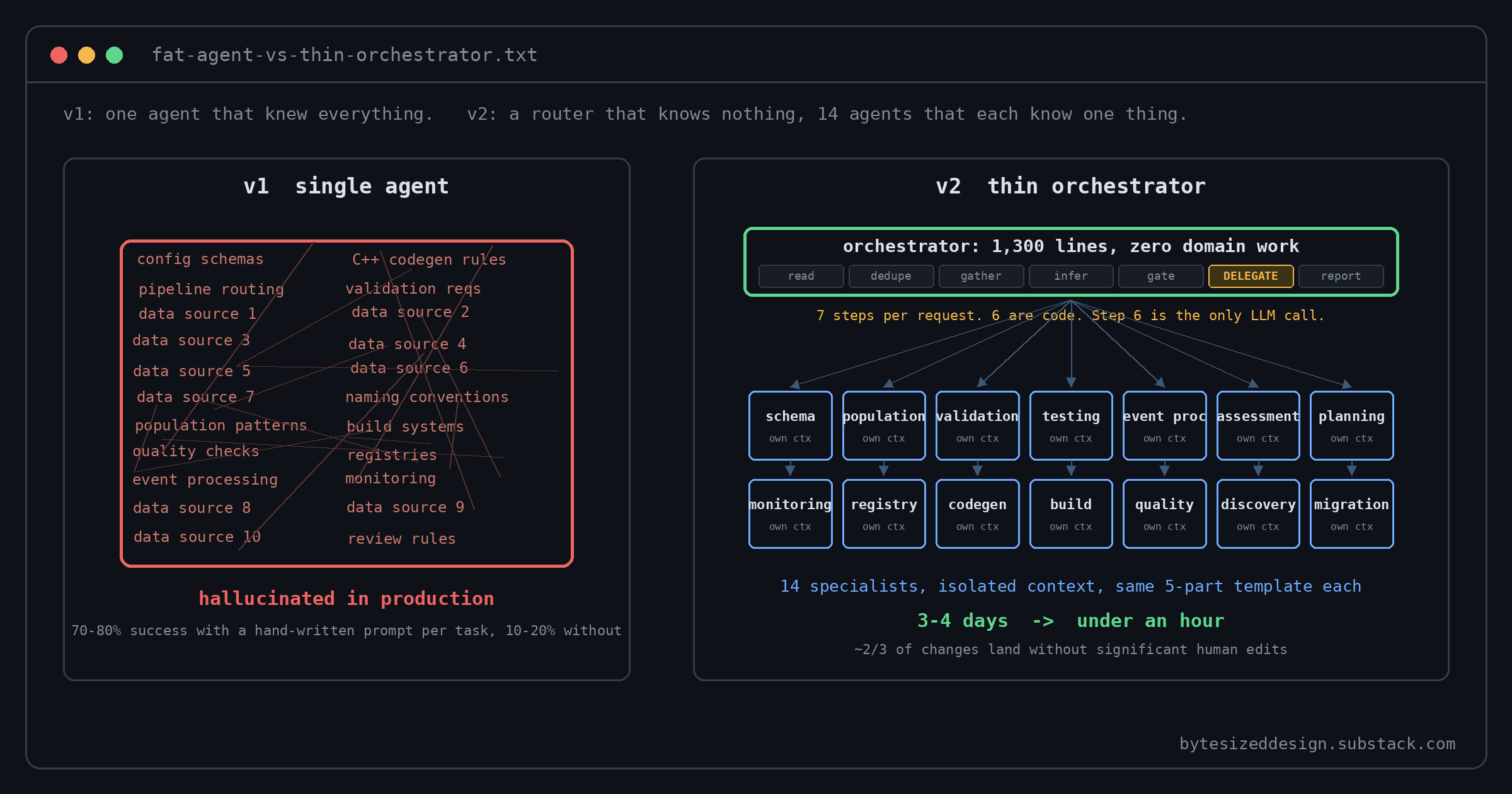
The 14 subagents are each a complete domain expert with isolated context. A schema agent knows the configuration registries. A population agent knows how to generate code for each of the ten data sources. A validation agent knows build systems and quality checks. No single agent sees the whole picture, which is what stops the cross-contamination that killed v1. The population agent for data source A has never seen data source B’s patterns, so it can’t apply them by mistake.
